Wednesday, March 12, 2014

Update: Bitcoin technical analysis

The Bitcoin market remains subdued following last month’s crash low, which came on the heels of the Mt. Gox debacle.  Since then the Bitcoin price has been consolidating above the late February low  and is showing signs of wanting to move higher in the near term.

Based on the rules of our technical discipline, a 2-day higher close above the 15-day moving average is needed to confirm an immediate-term bottom signal.  Bitcoin did manage to close decisively above the 15-day MA on March 3, but failed to follow through with a higher close.  It has remained below the Mar. 3 pivotal closing level ever since. 

Accordingly, a close above 677.69 (the Mar. 3 close) is needed to confirm an immediate-term bottom and renewed “buy” signal for Bitcoin.  This would not only fulfill the requirements of our technical discipline but would also establish a pattern of higher highs and higher lows, the definition of a renewed upward trend.  While we’re waiting for this signal, it’s interesting to note that Bitcoin has shown respect to the 15-day MA as a support/trend line in the last several days. 


Wednesday, March 5, 2014

Bitcoin's need for increased security

In an article for The Daily Ticker, Philip Pearlman writes of the need for increased security measures after bitcoin exchange Mt. Gox had $400 million stolen.  Mt. Gox was forced to file for bankruptcy last week after the recent theft, a move which caused panic among bitcoin investors and led to a temporary plunge in the virtual currency’s value.

As it turns out, Mt. Gox isn’t alone in its vulnerability to theft.  Over the last week, thefts have been reported at three different bitcoin sites.  Along with the $400 million stolen from Mt. Gox, Flexcoin had $600,000 in bitcoin stolen and the tiny exchange, Poloniex had 12% of its assets, amounting to $50,000, stolen.  Hackers have been probing for vulnerabilities at bitcoin exchanges, making them prime targets for robberies. 

As we discussed in last week’s commentary, a preliminary bottom was expected to be imminent and it came shortly after the announcement of the Mt. Gox debacle.  The negative publicity and selling panic that greeted the news was typical of the exhaustion phase of a major bear move, so it came as no surprise that bitcoin’s decline culminated last week.  Psychologically, most sellers have already exited the market and now the bargain hunters have re-entered. 

All that’s required to technically confirm an immediate-term bottom is for bitcoin to close two days higher above its 15-day moving average.  That hasn’t happened yet but it could by the end of the week. 


On a positive note, the Mt. Gox debacle has set the stage for some much-needed reforms in the bitcoin market.  As Pearlman observed, “with every attempt to hack into bitcoin operations, security officers at these companies learn more about the potential vulnerabilities inherent in running these types of operations which might potentially make them more secure” by allowing them adapt to security threats.

Tuesday, February 25, 2014

Bitcoin market nearing bottom, but problems remain


In my previous commentary I remarked that a bottom to the Bitcoin crash wasn't likely until the mainstream media began publishing negative headlines on Bitcoin.  Well the negative headlines have just started with the above video journalism piece by Reuters.  The intensity of negative sentiment behind this piece isn't quite strong enough to suggest emphatically that a bottom is in, but it does suggest a confirmed interim bottom is likely near.

On a related note, the apparent imminent bankruptcy of the Mt. Gox exchange has created a torrent of speculation as to the future of the electronic currency.  Experts point to the latest events as underscoring Bitcoin's ultra-speculative nature and lack of transparency.  The e-coin has been condemned by some as being more a commodity and less a currency.  The image problem currently plaguing Bitcoin has only been exacerbated by the Mt. Gox fiasco.

Bitcoin will undoubtedly survive this crisis, and its bear market will eventually end.  But until the dust settles investors are well advised to avoid new commitments to Bitcoin.  We continue to await a confirmed bottom signal from our indicators; for now the Bitcoin bear market remains intact.

Saturday, February 15, 2014

Bitcoin’s silent crash

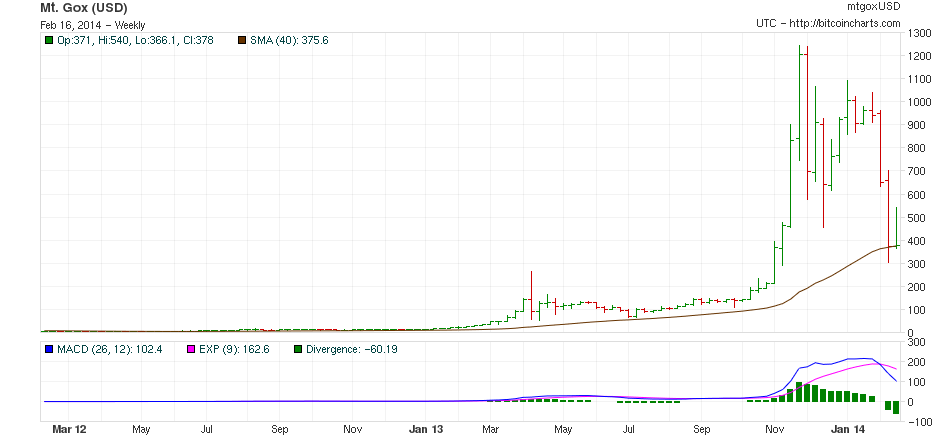
Bitcoin has recently suffered what may be termed a “silent crash” after a stellar performance in late 2013.  

After a blow-out performance in November, the Bitcoin price suffered a sharp pullback in December and spent most of January in a temporary holding pattern above the 900 level before finally sinking under the weight of selling pressure in February.  As of Feb. 14, the Bitcoin price was testing its dominant longer-term 40-week moving average, which answers to the widely followed 200-day MA.  This marks the first major test of a significant trend line for Bitcoin since last July.


The sell-off in the last two weeks has occurred under a veil of near silence among the mainstream media.  The same financial press which so vigorously praised the virtual currency’s prospects earlier this year has largely ignored the slide in value since Feb. 6.  This can be largely attributed to the recent equity market sell-off, which stole the spotlight from other investment vehicles. 

It’s nevertheless unusual that the media continue refusing coverage of the loss of Bitcoin’s value.  This leads us to speculate as to a possible motive.  One possibility is that the hedge funds which recently entered the Bitcoin market are using the decline as cover for accumulating a large stake in the market.  It’s no secret, after all, that many members of the financial press are in the employ (if not the outright ownership) of hedge fund moguls.  It’s therefore possible that the media silence on Bitcoin’s recent crash is bought and paid for by those who intend to ultimately profit from it.

Of course another reason for the lack of media interest in Bitcoin’s latest swoon is perhaps that the virtual currency has been temporarily overshadowed by the rally of the gold price.  Gold’s rally is a testament to its demand as a safe haven among investors spooked by the recent financial market turbulence, as well as the media hype regarding an emerging markets “crisis.” 


Until the media begins talking up Bitcoin’s crash in histrionic tones, investors should be wary of assuming the slide in the currency’s value has terminated.  The Bitcoin bear market is likely to persist until we see gloom-and-doom headlines announcing the currency’s demise, at which time we can justly assume a psychological turning point will be made.

Monday, January 27, 2014

PMX expands into Bitcoin arena

PMX Gold Bullion Sales has announced its entry into the Bitcoin arena.

Last year PMX launched its MGIV gold terminal in Boca Raton, Fla., which allows consumers to purchase varying denominations of fine gold bullion bars and coins using credit and debit cards.  

On Jan. 27 PMX said that the touch-screen terminal now has the ability to interface with most Bitcoin solutions already in the marketplace.

"The ability to mainstream an e-wallet into our precious metals terminal we feel helps commercialize the ability for a consumers to purchase Bitcoins,” Meris Kott, Managing Director of PMX Bullion Sales said.

Thursday, January 16, 2014

Bitcoin and the magazine cover indicator

It had to happen sooner or later and this week it finally did.  

The Bitcoin phenomenon made the front cover of a major news magazine when Bloomberg Businessweek ran a story on the intricacies of Bitcoin mining.  The impressionist art on the front cover was evocative of the dream of fabulous wealth entertained by many Bitcoin enthusiasts.


The question that naturally comes to mind is whether or not this qualifies as a legitimate "magazine cover indicator" and does it therefore have predictive value?  Historically, whenever an investment craze makes the front cover of a major magazine it reflects the saturation of that investment and implies that the value of said investment has (temporarily at least) overextended.  A "correction" or decline in the investment's value often follows soon thereafter. 

Bitcoin is a bit different than more classical investment crazes, however, and requires an entirely different set of tools to evaluate it.  The appearance of Bitcoin on the Businessweek cover likely doesn't signal the end of the craze -- especially since the vital ingredients of full-fledged mania status are missing, viz. strong institutional and hedge fund involvement and widespread public participation.  What the cover could signify, however, is the commencement of an extended "internal correction" in Bitcoin's value.  

An internal correction can be defined as a lateral trading range-type market in which consolidation takes place over an undetermined length of time.  This would give Bitcoin a much-needed rest and would also take some of the heat off the market by removing it from the mainstream media spotlight.  This is necessary from the vantage point of the hedge funds who need a dull, uneventful market in order to quietly build a substantial position.  

Don't be surprised, then, if Bitcoin posts an underwhelming performance for a while.

Friday, January 10, 2014

A look at Bitcoin's immediate-term prospects

Bitcoin’s price line remains above its dominant immediate-term uptrend.  The immediate-term trend is defined by the 15-day simple moving average (MA), with the trend considered up as long as Bitcoin’s price line remains above the rising 15-day MA. 

A decisive close under the 15-day MA would temporarily break Bitcoin’s immediate-term (1-3 week) forward momentum and put temporary pressure on the virtual currency.  This is why it’s important that we monitor the area around 900 where the 15-day MA intersects in the daily chart shown below.


As long as Bitcoin stays above this trend line next week, participants (read hedge fund speculators) are likely to soon make another attempt at pushing Bitcoin back up to the previous high from early December 2013.